The 7 Areas of Learning in British Curriculum Nursery Settings
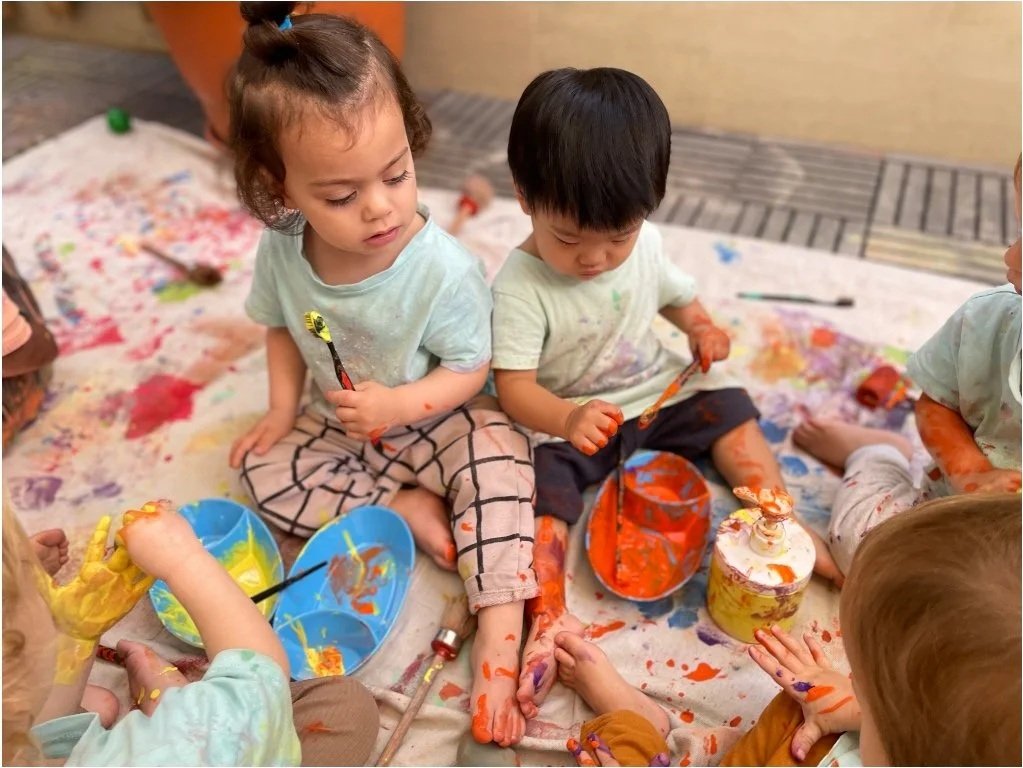
Children all begin in the same place, though curriculums measure their growth differently. Let’s explore how a British Curriculum Nursery would do that!
If you're considering a British curriculum nursery for your child, you've probably heard about the EYFS framework. But what does it actually mean for your child's day to day experience? Let us break down the seven areas of learning that shape how quality nursery settings view and support your child's development.
How does the Early Years Framework work?
The Early Years Foundation Stage divides development into three Prime Areas and four Specific Areas. The Prime Areas form the foundation, while the Specific Areas build upon them. Together, they create a holistic picture of your child's growth!
The Three Prime Areas: Building Blocks of Development
1. Personal, Social and Emotional Development
This covers everything from your baby looking toward the door when someone opens it, all the way to your four-year-old navigating complex, dynamic friendships.
It includes individual personal experiences like acknowledging and understanding their own feelings, managing those feelings appropriately and navigating tricky social situations.
Educators will begin to look at how your child separates from you, how they interact with peers, whether they can ask for help and how they begin understanding that others have different perspectives and feelings.
2. Communication and Language
From babbles to full conversations, children develop language from the moment they're born. This area encompasses far more than just talking, though!
It includes verbal communication obviously, but also using and understanding body language. Can your child follow simple instructions? Do they understand gestures better than words? Are they beginning to use language to negotiate, explain, question and connect?
In a British curriculum nursery, educators constantly model language, narrate their own actions, extend vocabulary and create a language rich environment for children to learn seamlessly within.
3. Physical Development
This covers everything from gross motor skills; such as throwing a ball, climbing stairs, running without falling, as well as fine motor control for holding writing tools correctly, being able to pinch and roll play-dough and using scissors.
Physical development also includes self-care skills like getting dressed, using utensils and eventually managing buttons and zips independently. Your child's growing body awareness, their increasing coordination and their developing strength all fall under this area.
The Four Specific Areas: Building on the Foundation
1. Literacy
Literacy starts much earlier than most parents assume, and it's about far more than reading and writing.
It begins with showing interest in the illustrations of a book, recognising that print carries meaning, starting to recall stories and their sequence and eventually recognising early phonics sounds.
A child who asks you to "read it again" for the twentieth time? That's literacy development. A toddler who scribbles on a page and announces they've "written a letter"? That's literacy too! The British curriculum nursery approach recognises that these early experiences matter enormously, even though they don't look like formal reading lessons.
2. Mathematics
The word mathematics encompasses far more than counting. Shape, space, time, capacity, number, measurement, pattern... these concepts are broad and genuinely hard to comprehend in the beginning!
British curriculum nursery settings make these skills interesting and fun by starting small and keeping them practical. Comparing whose tower is taller. Noticing patterns on clothing. Counting steps as you climb them. Filling and emptying containers with sand and water.
Mathematics is everywhere in play, and children absorb these concepts naturally when they're embedded in meaningful activities rather than taught through worksheets.
3. Understanding the World
This area covers general knowledge of the world, the people in it and what they do. It's endlessly broad and wonderfully curious!
It is everything from recognising seasons and the different holidays that are celebrated within them, to the tiniest of critters that crawl on the floor and why the sky is blue. In early years settings, this area holistically develops through exploration, observation, asking "why" questions and making connections between experiences.
4. Expressive Arts and Design
Children experience creation from the first time they mix colours of paint or pick up a crayon to doodle. But this area means so much more than simple art projects!
It includes creative thinking and problem solving, as well as expressing themselves through individual interests like dancing or movement and engaging in imaginative play.
A nursery promotes this thinking by providing open ended resources and allowing time for children to experiment, create, and express themselves without adult directed outcomes dictating what their work should look like.
How It All Comes Together Through Play
Here's the beautiful part: children naturally develop all seven areas through play in the early years. They don't need worksheets or outcome driven topics and activities.
The right British curriculum nursery setting allows children to achieve all these milestones through a play-based approach to learning. A true educator is able to recognise all the aspects of learning taking place when they observe a child building with blocks. It’s physical skills, mathematical understanding, problem solving and often social negotiation all at once.
While some children excel in one area more than others initially, they usually even themselves out over time. And when one interest is particularly strong? You end up with children who turn into your Picassos and your Einsteins. Those deep, passionate interests that emerge in early childhood often dictate their futures!
The best settings don’t try to make every child excellent at everything. It creates the conditions for each child to develop across all seven areas while honouring their individual strengths, interests and timelines.
Ready to discover how flexible nursery attendance could transform your return to work? Book a nursery tour today and let's discuss an attendance pattern that works perfectly for your family's unique needs.