Play-Based Early Childhood Day Care: Why It Matters More Than Academics
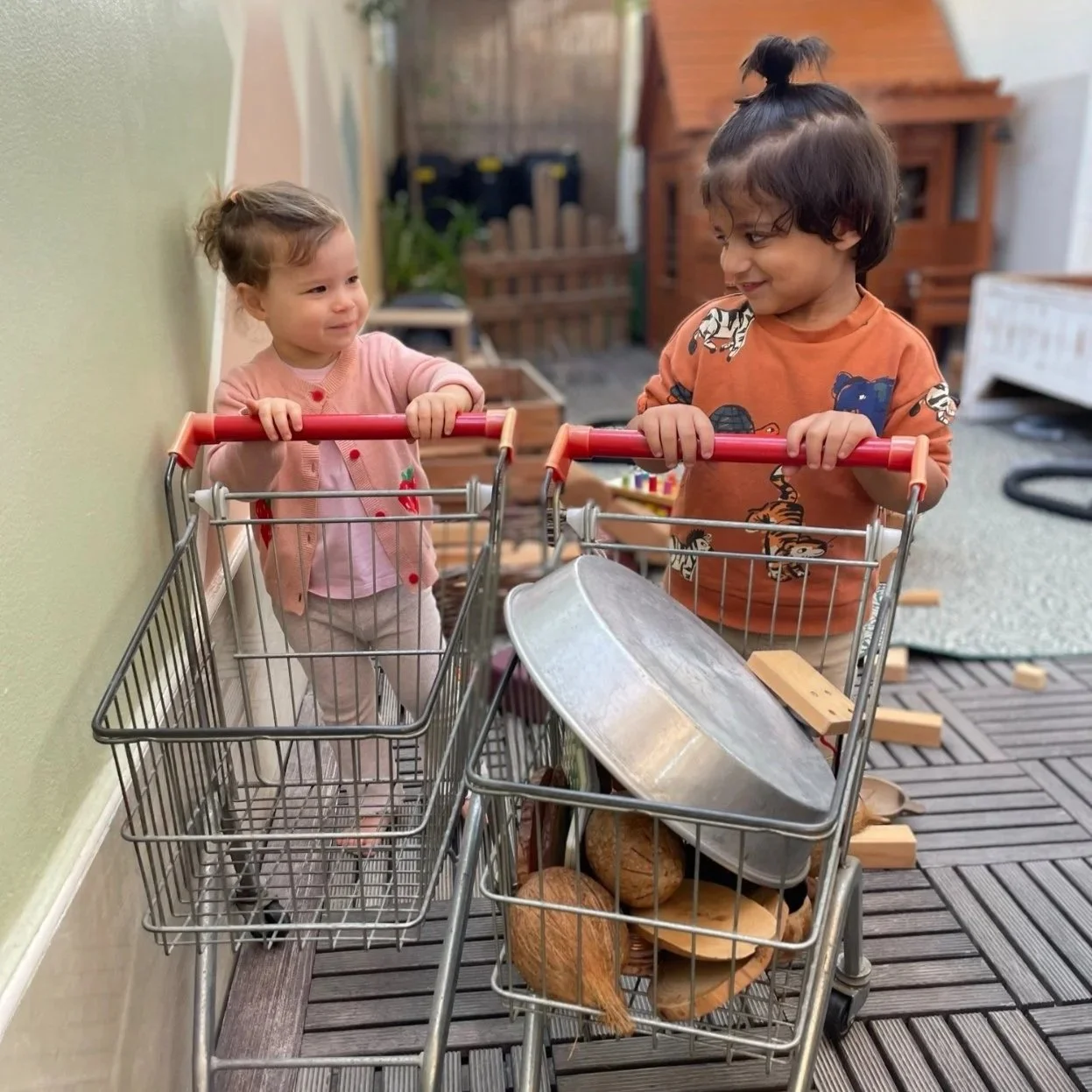
Let’s get down to what your priorities should really be when you look for day-care!
You're touring nurseries in Dubai, and one has flash cards displayed proudly on the wall. Children sit in rows, reciting numbers to twenty. Another has mud kitchens, building blocks, and children laughing as they construct elaborate imaginary worlds. Which one feels right?
If you chose the second but worry your child will fall behind, you're not alone. Many parents choosing early childhood day care wrestle with this tension between play and academics.
The Brain Science Behind Play-Based Learning
Here's what most people don't realise: the early childhood brain is built to understand personal, social and emotional development first. Alongside this comes physical development (both gross and fine motor skills) and language development. These are the foundational building blocks.
Literacy and mathematics? They come next, developmentally speaking. Trying to force academic concepts before a child's brain is ready is like building the roof before the walls, it will just confuse the process.
Sometimes, we do tours for prospective parents and they proudly let us know that their 2 year old can tell you the names of all the planets in order. And while that is extremely impressive, it’s not what we are looking for. A toddler that can confidently leave their parents side to go explore a playroom on a tour? Now that is an eye catcher!
Play-based early childhood day care is set up to honour this developmental sequence. When a three-year-old negotiates turn-taking on the slide, they're building executive function skills that will directly support reading comprehension later. When they balance on a log, they're developing the core strength needed for sitting at a desk and the hand-eye coordination required for writing.
Why Children Need Time and Space (Even When It Looks Like Nothing)
Modern childhood has become incredibly scheduled. Swimming at 4pm, Mandarin on Tuesdays, phonics practice before bed. But here's the uncomfortable truth: children learn best when they have unstructured time and open-ended space.
Boredom is actually a gift. When children aren't entertained constantly, they develop problem-solving skills and imaginative play. They learn to generate their own ideas rather than waiting for adult direction; a skill that creates innovative thinkers, not compliant test-takers!
At Kid's Island, we intentionally create spaces where children can access loose parts in their play, invent their own games and curate their own environments within a play area to fit their narrative!
What Early Literacy and Numeracy Actually Look Like
This is where the confusion happens. Parents see their friend's child writing their name at the age of three and begin to panic. But genuine early literacy and numeracy look nothing the imagine of formal academics that’s in your head!
Real early literacy includes:
Genuine interest in books, illustrations and storytelling, not just memorising words
Sentence formulation through conversation and play narratives
Name recognition in meaningful contexts (their snack bag tag or their artwork)
Understanding that print carries meaning (recognising a stop sign and what it means and knowing their favourite book by its cover)
Real early numeracy includes:
Working with shape and space through building and construction
Understanding capacity through pouring water or filling containers
Recognizing patterns in nature, music, and daily routines
Understanding the concept of time through routines and daily occurances
Notice what's missing? Phonics drills, reciting numbers to twenty and workbook pages. These might create the illusion of learning, but they bypass the deep conceptual understanding that play provides.
A child in play-based early childhood day care who builds increasingly complex block towers understands spatial awareness, gravity, balance, and problem-solving. These concepts directly translate to mathematical thinking later, giving them a strong foundation for later learning.
The Beautiful Truth About Developmental Readiness
Here's what you need to know: when children start formal school, their brains will be ready to absorb tougher concepts because it's the right time for them developmentally.
Children who spend their early years playing, exploring, and developing strong social-emotional foundations consistently catch up to (and often surpass) children who were drilled in academics early. Why? Because their brains are developmentally ready. They have the emotional regulation to handle frustration when learning gets hard. They have the physical stamina to sit and focus. They have the language skills to ask questions and express confusion.
The child who learned phonics at two isn't automatically a better reader at seven. But the child who spent those early years building resilience, curiosity, and confidence? They have advantages that last a lifetime.
Quality early childhood day care doesn't ignore learning. It simply recognises that the most important learning in early childhood happens through play, not despite it. Your child isn't falling behind when they spend the day building, imagining, and exploring. They're building the exact foundation their brain needs for every academic challenge ahead.
Get in touch to book a tour of our nursery school, or book a stay-and-play nursery school session to see how your child experiences the nursery school. Or get in touch with Kid’s Island Nursery School, Dubai for any other questions you might have.